 Comparison
Artist Designed Apparel vs AI: What Buyers Need to Know
Last Updated: November 15, 2026
Quick Summary
Artist designed apparel is clothing where a named creator made the visual decisions, and that authorship is part of what you're buying. AI-generated art starts with a prompt and a model filling in the gaps, so it can mimic an aesthetic but can't opt into a story. The real gap isn't image quality, it's intent.
- Spot AI art by fraying line endings, muddy color counts, and placement that ignores the garment.
- Ask sellers who owns the file, what the commercial-use terms are, and whether a human edited the final file.
- Screen printing needs flat, countable colors, so AI files with thousands of shades must be separated by hand.
- If you're selling apparel yourself, budget for a human separation pass on every AI file before it hits a screen.
- Siren & Ember uses AI-assisted artwork with human decisions, printed to order, and says so plainly.
Table of Contents
- Artist Designed Apparel vs AI: The Core Difference
- AI Art vs Human Art: Creativity, Authenticity, and Storytelling
- How to Spot AI-Generated Art Before You Buy
- Inside the AI-Assisted Design Process
- Print Production Constraints: Why Design Origin Shows Up on the Shirt
- Pick the Shirt That Tells Your Story
- Frequently Asked Questions
Artist Designed Apparel vs AI: The Core Difference
Artist designed apparel starts with a person making choices: what the design says, where it sits on the garment, and how it will print. AI-generated art starts with a prompt and a model filling in the gaps.
At Siren & Ember, every design is printed to order, and some of our artwork is made with AI assistance.
AI can produce an image fast. It cannot understand a garment.
Below, we break down where the two approaches diverge, how to spot the difference, and how to choose.
AI Art vs Human Art: Creativity, Authenticity, and Storytelling
The real gap isn't image quality. It's intent.
A human artist builds a design around a story: a Norse reference, a cryptid joke, a phrase that means something to a specific person. That intent shapes every choice, from line weight to color count.
Researchers at the University of Minnesota ran three online experiments on how people judge the authenticity of AI-designed clothing, and the work sits at the center of this debate: Human vs. AI: The Battle for Authenticity in Fashion Design and Consumption. A 2024 study in Archives of Design Research also documented real friction for designers using generative AI, including bias and intellectual-property concerns. Neither study hands you a verdict. Both point at the same thing: buyers care about where a design came from.
That's also where storytelling lives. A design that references kraken lore or a stubborn, no-excuses mindset carries a message the wearer opted into. AI can mimic the aesthetic. It can't opt in.
How to Spot AI-Generated Art Before You Buy
You can spot most AI-generated art by looking for three things: artifacts in fine lines, colors that don't separate cleanly, and compositions that ignore where the print sits on the body. But spotting the image is only half the job. The other half is spotting the paperwork, because the biggest risk with AI apparel isn't a weird hand, it's a design you can't legally own or a seller who can't tell you where the file came from.
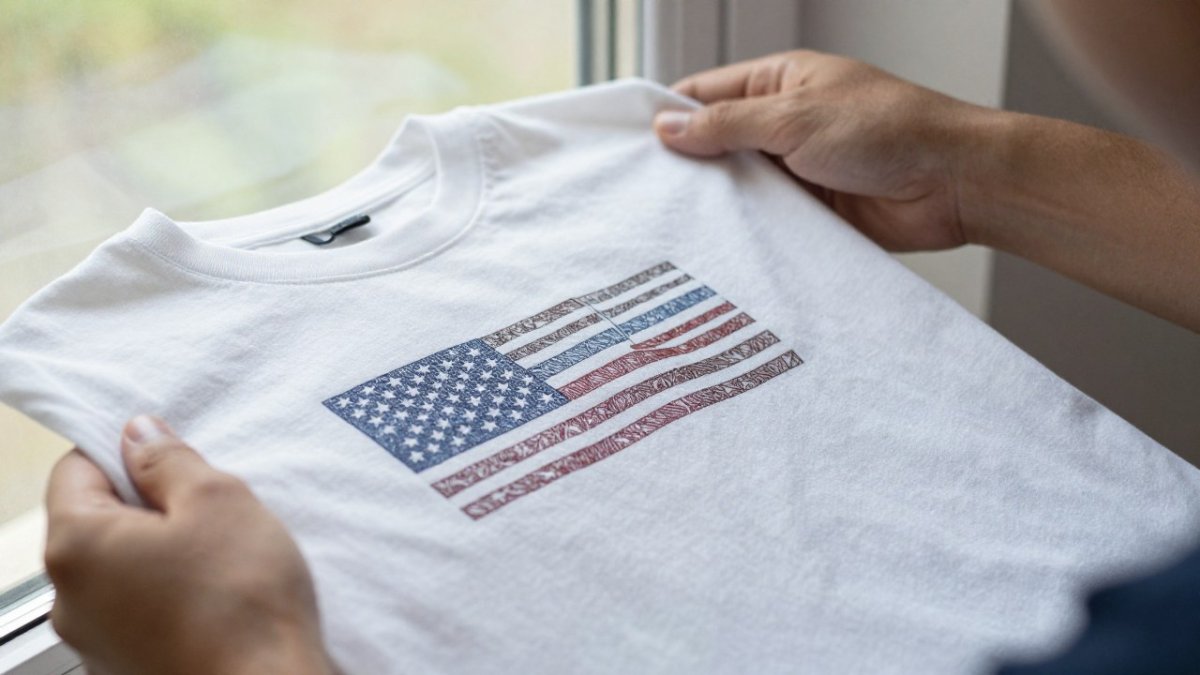
Start with a close look at the image itself:
- Line endings that dissolve. Zoom in. Human linework terminates deliberately. AI linework frays, doubles back, or blends into a neighboring shape.
- Nonsense detail. Extra fingers, melted letterforms, symmetrical blobs that read as decoration but mean nothing.
- Muddy color counts. Generative images often use hundreds of subtle shades. Screen printing works in flat, countable colors, so a design that needs gradients wasn't built for print.
- Placement that ignores the garment. A design centered on a flat rectangle often lands wrong on a real chest, collar, or seam.
- Text that almost reads. AI letterforms often warp at the edges or repeat a letter with subtle differences. Real typography is consistent.
Then ask the seller directly. Who made this? To judge print quality alongside design quality, our guide on how to spot quality custom prints before you buy walks through what to check on the fabric itself.
The paperwork check most buyers skip. Copyright protection for AI-generated images is a legal question that depends on how much human authorship is involved, and if you're buying a design to resell, or commissioning a logo for your own brand, that distinction matters. Ask three questions before you pay:
- Who owns the file? Get it in writing. A seller who can't state ownership terms is a red flag.
- What are the commercial-use terms? Some AI tools restrict commercial use or require attribution. The seller should know which tool was used and what its terms allow.
- Was the final file human-edited? A human who redraws, arranges, and finalizes a design is doing authorship work. That's different from a raw prompt output.
Watch out: a clean product mockup tells you almost nothing. Mockups are rendered, not photographed.
A practical rule: if the listing shows a perfect flat image, no real garment photo, no artist name, and no process description, you're probably looking at a prompt-and-publish operation. That doesn't automatically make the shirt bad.
Inside the AI-Assisted Design Process
AI-assisted design is a workflow where a person uses generative tools for part of the image-making and makes the final calls themselves. The tool drafts. The human edits, rejects, and rebuilds.
That distinction matters because the failure mode of AI art isn't ugliness. It's the absence of a decision-maker. A prompt-and-publish workflow skips the steps that make a design printable:
- Concept. A human defines the joke, the reference, or the mood.
- Drafting. Generative tools produce candidates quickly.
- Redraw. The chosen draft gets rebuilt with clean, countable colors and deliberate line weights.
- Placement. The design is sized and positioned for the actual garment.
- Proof. The file is checked against print constraints before anything goes to production.
A commercial apparel-design argument makes the same case: AI can generate images but doesn't understand screen-printing limits, garment placement, or color, which is why custom apparel needs both AI art and human artists working together. We agree with the framing. The tool is useful. The judgment has to stay human.
Print Production Constraints: Why Design Origin Shows Up on the Shirt
Screen printing is a stencil process, and stencils have rules. Each color needs its own screen. Fine detail has to survive the mesh.
Garment placement matters too. A print has to sit correctly relative to the collar and the shoulder seams.
| What to check | Why it matters | What good looks like |
|---|---|---|
| Color count | Each color needs its own screen | Flat, countable colors |
| Line weight | Fine lines drop out in mesh | Deliberate, consistent lines |
| Edges | Soft edges print muddy | Crisp, separated shapes |
| Placement | Flat mockups mislead | Sized for the actual garment |
| Seam alignment | Prints cross seams unevenly | Positioned to avoid distortion |
| Halftones | Gradients need dot patterns, not smooth blends | Intentional dot structure, not accidental blur |
The buyer's decision framework. Most articles frame this as a debate. Here's the practical version, match the design origin to what you're actually buying:
- If you want a one-off graphic and don't care who made it: an AI-generated file is fine, provided the seller has separated it for print and shown you a real garment photo.
- If you're buying for a brand, team, or event: ask who owns the file and what the commercial-use terms are. A design you can't license is a design you can't build on.
- If you want a design with a point of view: look for a named creator and a stated process. Authorship is the thing you're paying for.
- If you're selling apparel yourself: assume every AI file needs a human separation pass before it hits a screen. Budget for that step or your prints will show it.
None of this is about whether AI touched the file. It's about whether a person checked the file against the press, and whether you, the buyer, can trace the design back to someone who made the call.
Pick the Shirt That Tells Your Story
The right choice comes down to what you want the shirt to do. If you want a fast, cheap graphic and you don't care who made it, AI-generated art will get you there.
Our own answer is a hybrid: AI-assisted artwork, human decisions, printed to order. Some of our designs use AI tools during drafting, and we'll tell you that plainly rather than pretend otherwise.
If you want to see what that looks like on an actual garment, start with a design that carries a story. The Sasquatch unisex tee is a good example of cryptid artwork with a sense of humor, the Savage Heart women's tee puts a personal, human voice on a shirt, and the Merry Mayhem holiday tee shows how a seasonal design can still have personality.
The challenge is simple: apparel online often gives you no way to tell who made the design. We'd rather you could.
Frequently Asked Questions
How can you tell if apparel art was made with AI?
Look for telltale visual artifacts: extra fingers, melted linework, inconsistent shading, or patterns that blur at the edges. Zoom in on the design file or product photo. Ask the brand directly who created the artwork and whether AI tools were used. Reputable artist designed apparel brands will answer honestly.
What is the difference between artist-designed and AI-generated apparel?
Artist-designed apparel starts with a human creative process: an artist sketches, refines, and prepares artwork with garment placement and screen-printing limits in mind. AI-generated designs are produced by tools that generate images from prompts. The difference matters in originality, storytelling, and print quality. AI does not understand screen-printing limitations, garment placement, or color separation, so human oversight is still needed for production-ready art.
Can a human artist use AI tools in a design?
Yes. Many artists use AI-assisted design as part of their workflow, generating references or rough concepts before refining the final artwork by hand. The key is transparency. Siren & Ember designs may use AI-assisted artwork, and the brand does not claim every design is hand-drawn. What matters for buyers is that the final design reflects creative intent, not just generated and uploaded.
Does AI-generated art look different when printed on a shirt?
It can. AI images often contain subtle gradients, noise, or vector artifacts that do not separate cleanly for screen printing. Human artists generally prepare files with print production in mind, and buyers often perceive AI-designed apparel differently. Always check real product photos, not just digital mockups.